Aurora planning · 4 min read · Updated July 2026
Norway Aurora Cruises: When to Book 2027 Sailings
Booking tips for 2027 Northern Lights cruises — and why sailing in October gives you better odds than most people expect
The best time to sail for the aurora isn't December or January. It's October — and the season is short enough that fixed dates cost you choice.
There is a particular kind of optimism that people bring to planning an aurora cruise. They imagine December, polar night, the snow piling up to the windows, and then — if they’re lucky — a curtain of green light overhead. It sounds wonderful. And it can be. But the people who have done it a few times tend to steer you towards October.
Here is why.
The aurora season at a glance
The northern lights are a year-round phenomenon above the Arctic. But you can only see them against a dark sky. In northern Norway, the midnight sun washes out the heavens from roughly May to July — so there is simply no darkness to view against. The practical season runs from about late August to early April, with the heart of it in the deep-dark months on either side of midwinter.
This means the aurora season and the booking season are not the same thing. Most people book the December and January dates first, because the romantic idea of polar-night aurora travels fastest. The problem is that the best aurora months — the ones with the cleanest skies — are also the cloudiest, and you are often trading light for wet.
Why October is the quietly smart month
October sits at the top of my list for a few practical reasons:
- The skies tend to clear. Late summer and early autumn can be surprisingly reliable. Cloud is the single biggest enemy of aurora viewing — far more important than solar activity — and October often offers a window before the full winter weather arrives.
- The solar backdrop is still favourable. The Sun entered its solar-maximum period in late 2024 (announced by NOAA and NASA in October 2024), and activity on the declining side of a cycle stays well above quiet-year levels for years, not months. October also sits close to the autumn equinox — a stretch when geomagnetic activity is statistically stronger.
- The daylight is still reasonable. You can still do a proper daytime excursion, walk along the quay, find a warm cup of coffee. Polar night is beautiful, but it is also short — there is less to do besides wait for the lights.
- It is a shoulder month. October sits between the end of the midnight sun and the start of deep winter — neither the light half of the year nor the depths of it. What any particular sailing costs, and how full it is, is a question for the operator and the date.
October is not perfect, of course. The darkness is still growing each week. Some storms can hit hard. But the trade-off — fewer clouds, reasonable daylight — tends to favour it.
Solar maximum and 2027
This is the part that most people do not plan around. The Sun runs on roughly an eleven-year cycle of activity, and NOAA and NASA announced in October 2024 that Solar Cycle 25 had entered its maximum period — a window forecast to last a year or more, with elevated activity persisting well beyond it. Even as the cycle turns, the declining phase historically keeps producing strong displays. That is a genuinely favourable backdrop for a 2027 trip — we look at the timing question in detail in Is 2027 still solar maximum?
This is worth bearing in mind when you are thinking about when to go.
When to book a 2027 cruise
Two things are worth holding in your head here, and neither of them is a deadline.
The first is the size of the ships. The vessels on the Norwegian coastal route are small by cruise standards — hundreds of passengers, not thousands — so any single departure has a limited number of cabins in it, and fewer still in any one grade. The second is the length of the season. Darkness is what makes the aurora visible at all, and in northern Norway that runs from roughly late August to early April. Between those two facts, a fixed date is genuinely constraining: if you can only travel in one particular week, you are choosing from a much smaller set of sailings than someone who can take any week in the season.
How far ahead a given sailing actually fills is a live number, and only the operator holds it. It varies by ship, cabin grade, route and year, and I have no figures worth quoting you. So the honest advice is not “book by month X” — it is this:
- Fixed dates narrow your options. If you are tied to a school holiday, an anniversary or a single free week, say so at the start of the conversation rather than at the end of it. That constraint shapes everything else.
- Ask about the dates you want, directly. Availability for a specific 2027 departure is something you can find out rather than guess at. It is worth asking for the real answer instead of working from anyone’s assumption about how quickly things go — including mine.
- Look for flexibility. A cruise that lets you shift dates within the season is worth more than one locked to a fixed calendar. Weather is unpredictable, and the ability to reschedule a night or two can be the difference between seeing the lights or not.
- The solar backdrop is a window, not a countdown. Cycle 25’s maximum is a period of elevated activity rather than a single date, and the declining side of a cycle keeps producing strong displays for years. It is a reason to feel good about a 2027 trip. It is not a reason to rush a decision.
Cruise versus land-based
The other question people ask is whether a cruise is a better way to see the aurora than staying in a hotel or lodge. There are advantages:
- Mobility. A ship can move away from cloud. On land, you are stuck where you are, driving an hour to find a gap if you are lucky. At sea, the vessel can sail towards clearer skies.
- Open decks. Most ships have open-air decks where you can stand under the sky without having to dress for a walk in minus temperatures.
- Dark horizons. If you are sailing along the coast, the sea gives you unobstructed views in all directions.
But there are trade-offs. A cruise can be expensive. The weather at sea is wilder — on some nights, you will not want to go on deck at all. And not every aurora cruise is designed with you in mind; some are just scenic voyages that happen to pass through the auroral zone, without any real focus on the lights. If you are weighing the ship types themselves, our comparison of the coastal steamer versus the expedition ship walks through which suits which traveller.
This is why I always say: talk to Jo before you book. She can point you to the cruises that actually run during the aurora season in Norway, and help you decide whether a cruise is the right choice for your trip. True Frontier In Action does not book travel — but Jo does, through an ATOL-protected travel company.
The honest bottom line
If you are planning a 2027 aurora cruise for Norway, here is my quick summary:
- Aim for October–November sailings for the best mix of clear skies and reasonable daylight.
- If your dates are fixed, start the conversation early — small ships and a short season leave less room to move.
- Treat the solar maximum as a favourable backdrop, not a countdown. It is one of four things that have to line up, and none of them can be promised.
- Talk to Jo about whether a cruise fits the kind of trip you want.
No one can guarantee the northern lights. But the people who give themselves the best chance are usually the ones who plan early, pick the right months, and keep their expectations honest.
And before you go, use the free Tonight Score each evening on your trip — it only says “go” when darkness, cloud, moon and solar activity all line up.
When you are ready to plan, Jo can help you think through an aurora cruise to Norway. She does not sell cruises or book trips, but she is always glad to help you think it through.
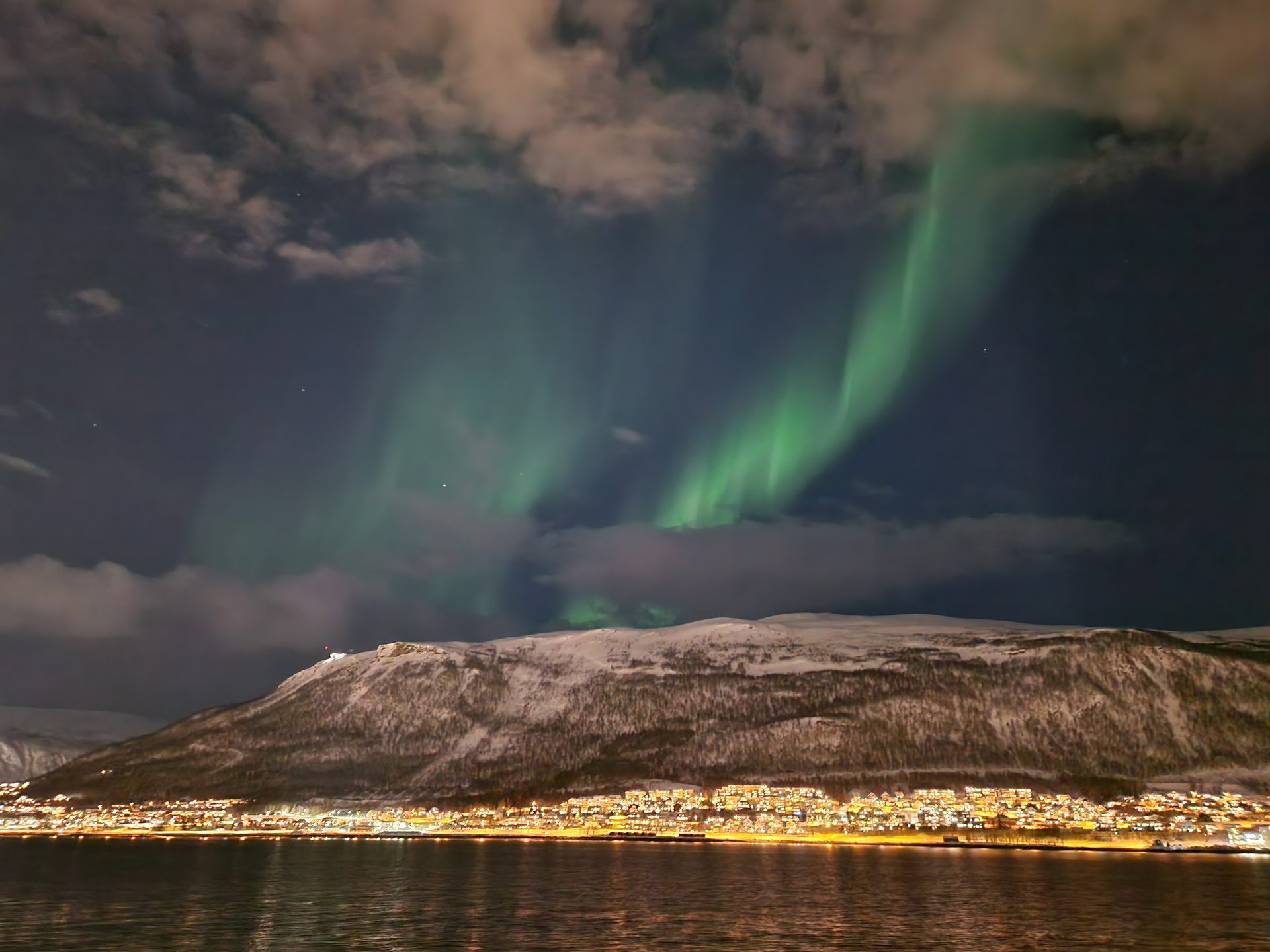
Above: Bright green aurora ribbon arcing over a snow-capped ridge above the golden lights of Tromsø..
Ready to put it into practice?
Check tonight's honest forecast for free, or plan a journey to where the aurora lives.