Aurora forecasting · 7 min read · Updated August 2026
The Best Northern Lights App: An Honest Comparison (Including Where We're Worse)
Every aurora app comparison is written by someone with an app to sell. So is this one — which is why it starts with the four things ours doesn't do.
Ask one question of any aurora app: when the sky is completely clouded over, can a high solar number still make it say go?
“Best northern lights app” is one of the most-searched questions in this subject, and almost every answer to it is written by someone with an app to sell, an affiliate link to place, or both.
So: we make one. That is a conflict of interest, and pretending otherwise would be worse than declaring it. The way we can be useful anyway is to start with the things ours does not do — the reasons you might reasonably choose something else — and then give you a way to judge any aurora app on its method rather than its marketing.
We are not going to name other apps, rank them, or describe features we have not personally verified in a product we do not control. That kind of comparison goes stale in weeks and is usually wrong on the day you read it. Approaches age much more slowly than feature lists.
First, the four things our app does not do
1. There is no sky-camera network
Some aurora tools plug into networks of all-sky cameras — live feeds pointed at the sky from fixed sites, so you can look at what a location actually looks like right now.
We have nothing like that. If you want to see whether it is genuinely clear over Tromsø at this moment, or catch the first green on a live feed, we cannot help you and a camera-network tool can. That is a real advantage and it is not one we are working around.
2. There is no aurora oval map
The familiar green-and-red oval draped over a globe or a polar map — the visual forecast of where the auroral oval currently sits — is not something we render. It comes from models like NOAA’s OVATION, which is public and used widely; a number of tools present it well.
Ours gives you a verdict for your location instead of a picture of the whole hemisphere. Some people want the picture. If you are the sort of person who wants to see the oval’s shape and judge for yourself, an oval-map tool suits you better than we do.
3. It is not out yet
There is no App Store listing, no Play Store listing, and no download. Right now you can join a waitlist and be told when it launches, and that is all. Every other app you are comparing is a thing you can install tonight; ours is not. If you are travelling next week, install one of those.
4. There is no published accuracy figure — and we are not going to invent one
This is the honest weak point, and it is the one we care most about.
The most persuasive claim any aurora forecast could make is a calibration figure: here is how often our go verdict was followed by a sighting, and how often our no-go verdict was right that there was nothing to see. For a product whose entire pitch is honesty, that number is the product.
We do not have it. Not enough verified outcomes exist yet to state a rate we would stand behind, so there is no TFIA accuracy figure anywhere on this site, and there will not be one until the data exists. When it does, the number will be published with its method attached: sightings and clouded-out nights counted separately, false alerts and missed alerts counted separately, a confidence interval on every rate rather than a bare percentage, and a named baseline — such as raw Kp alerting from NOAA’s Space Weather Prediction Center or AuroraWatch UK — beside every headline figure, so you can see what the improvement is measured against.
Until then, our claim is the method, never a number. If that is not enough for you, that is a completely reasonable position to take.
What we do differently: hard gates instead of a weighted average
Here is the one genuine design difference, and it is worth understanding whichever app you end up using.
Most aurora alerting reduces to a weighted average. Several inputs — most often just geomagnetic activity, sometimes activity plus cloud — get combined into a single score, and each input can compensate for the others. Push solar activity high enough and the score crosses the alert threshold regardless of what the sky is doing. That is why apps cry wolf: a big number under a solid cloud deck still fires the notification.
We treat two of the four factors as hard gates instead:
- Darkness is a gate. If it is not properly dark where you are, the answer is no, at any activity level.
- Cloud is a gate. If the sky is socked in, the answer is no, at any activity level.
- Moon is a weighted penalty — a bright moon dims a faint display without making it impossible.
- Solar activity is the engine, weighted — necessary, never sufficient.
The consequence is that our score can say no on the loudest night of the year, and that is the behaviour we want. How we score a night — and why we say no sets the logic out in full, and why clear skies matter more than solar hype explains why cloud earns a veto rather than a weighting.
The forecast, the Tonight Score and basic alerts are free, and we intend them to stay free — we are not going to build a product that charges you to find out whether to ignore it.
How to judge any aurora app in five questions
Use these on whatever you are considering, including ours.
1. Does cloud veto, or merely adjust? The single most revealing question. Find a completely overcast night with high geomagnetic activity and see what the app tells you. If it still says go, it is an activity alarm wearing a forecast’s clothes.
2. Does it know whether it is dark? Check it in daylight, or in June. An app that will alert you during the midnight sun is not modelling visibility at all.
3. Does it account for the moon? Look for the moon anywhere in the interface. Plenty of tools ignore it entirely. It rarely ruins a strong display, but on a marginal night it is the difference between something and nothing.
4. Does it publish its method? Can you find out what goes into the number, and in what proportion? “Proprietary algorithm” means you are being asked to trust a black box. You are allowed to want the recipe.
5. If it publishes an accuracy figure, does it publish the methodology too? A bare percentage with no sample size, no time period, no definition of a hit and no baseline is a marketing number, not a measurement. Ask what it was compared against. If the app cannot tell you, treat the figure as decoration. (This test is why we currently fail our own question four-and-a-half — see above.)
Which approach suits which person
Approaches, not products:
- Alert-first apps suit people who live under or near the auroral oval and can be outside in thirty seconds. When stepping out costs you nothing, a false alarm costs you nothing either, and you would rather be pinged too often than too rarely.
- Camera-network tools suit people who want ground truth right now — checking a live feed before committing to a drive, or watching remotely from a latitude where seeing it in person is not on the cards.
- Oval maps suit people who enjoy reading the forecast themselves and want the spatial picture rather than a verdict.
- Gated go/no-go forecasts — our approach — suit travellers with a small, expensive number of nights, where the cost of a wasted evening is high and a wrong “go” burns something you cannot get back.
Most serious aurora chasers end up using more than one. That is a sensible thing to do, not a failure of any of them.
Where this leaves us
The best northern lights app is the one whose failure mode you can live with. Alert-first tools fail by sending you out on nights you cannot see anything. Gated forecasts like ours fail by occasionally telling you to stay in on a night that turned out fine. Neither is free of error, and anyone claiming otherwise is selling something.
What we can say without qualification is what we have chosen: darkness and cloud as hard gates, the moon and solar activity weighed honestly, a documented method you can read, no aurora ever guaranteed, and no accuracy figure until we can publish one with the maths attached. You can join the waitlist here — and if none of that persuades you, use something else with our blessing. The point is that you see the lights, not that you use our thing.
If your real limitation is latitude rather than software, no app fixes that. Jo plans Arctic journeys around the places with the longest dark seasons — Finnish Lapland sits squarely beneath the auroral oval, which is the sort of advantage no forecast can manufacture. True Frontier In Action does not sell or book travel. With your consent we pass your enquiry to Jo Sehgal, a specialist at an ATOL-protected travel company, who handles any booking and its financial protection.
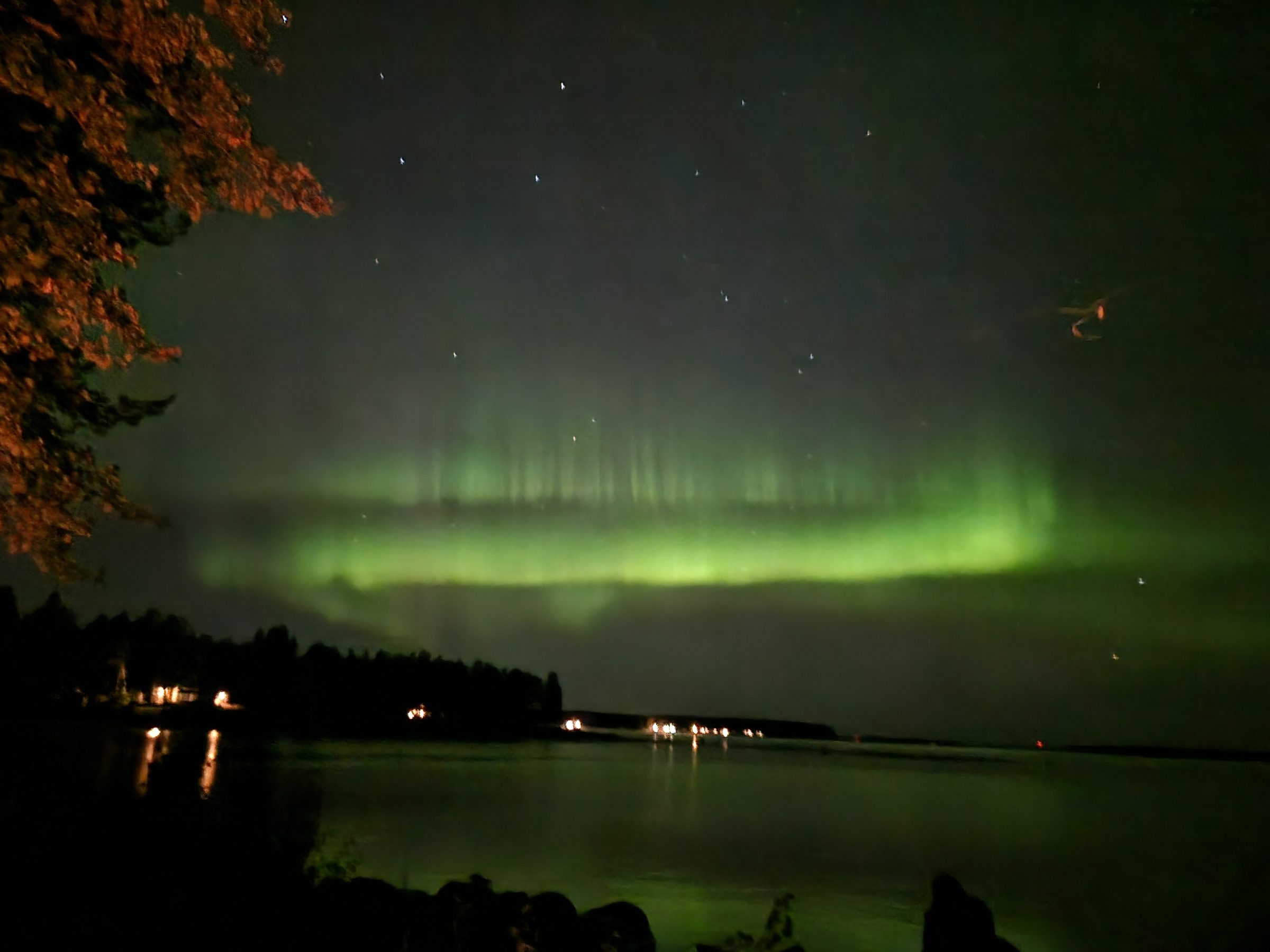
Above: A bright green aurora band stretched low across the sky and mirrored in a still Lapland lake, with shoreline lights below..
Ready to put it into practice?
Check tonight's honest forecast for free, or plan a journey to where the aurora lives.