Aurora planning · 4 min read · Updated June 2026
What the Aurora Really Looks Like to the Naked Eye
Why a camera shows vivid green and pink while your eyes see pale grey — and how to give yourself the best possible view
A faint aurora is a moving thing first and a coloured thing second — your eyes catch the motion long before the colour.
If you have only ever seen the aurora in photographs, the real thing can take you by surprise — sometimes in the best way, occasionally in a quieter one. The honest truth is that your eyes and a camera are two very different instruments, and they do not see the same sky. Knowing the difference before you go is the single best thing you can do to make sure you come away thrilled rather than let down.
This guide sets fair expectations, then shows you how to give your own eyes the best possible chance.
Why the camera and your eyes disagree
Your eyes have two kinds of light-sensing cells. Cones handle colour but need a fair amount of light to work. Rods are far more sensitive in the dark, which is what lets you find your way by starlight — but rods are very poor at colour. At night your vision leans almost entirely on rods, so the world arrives mostly in shades of grey.
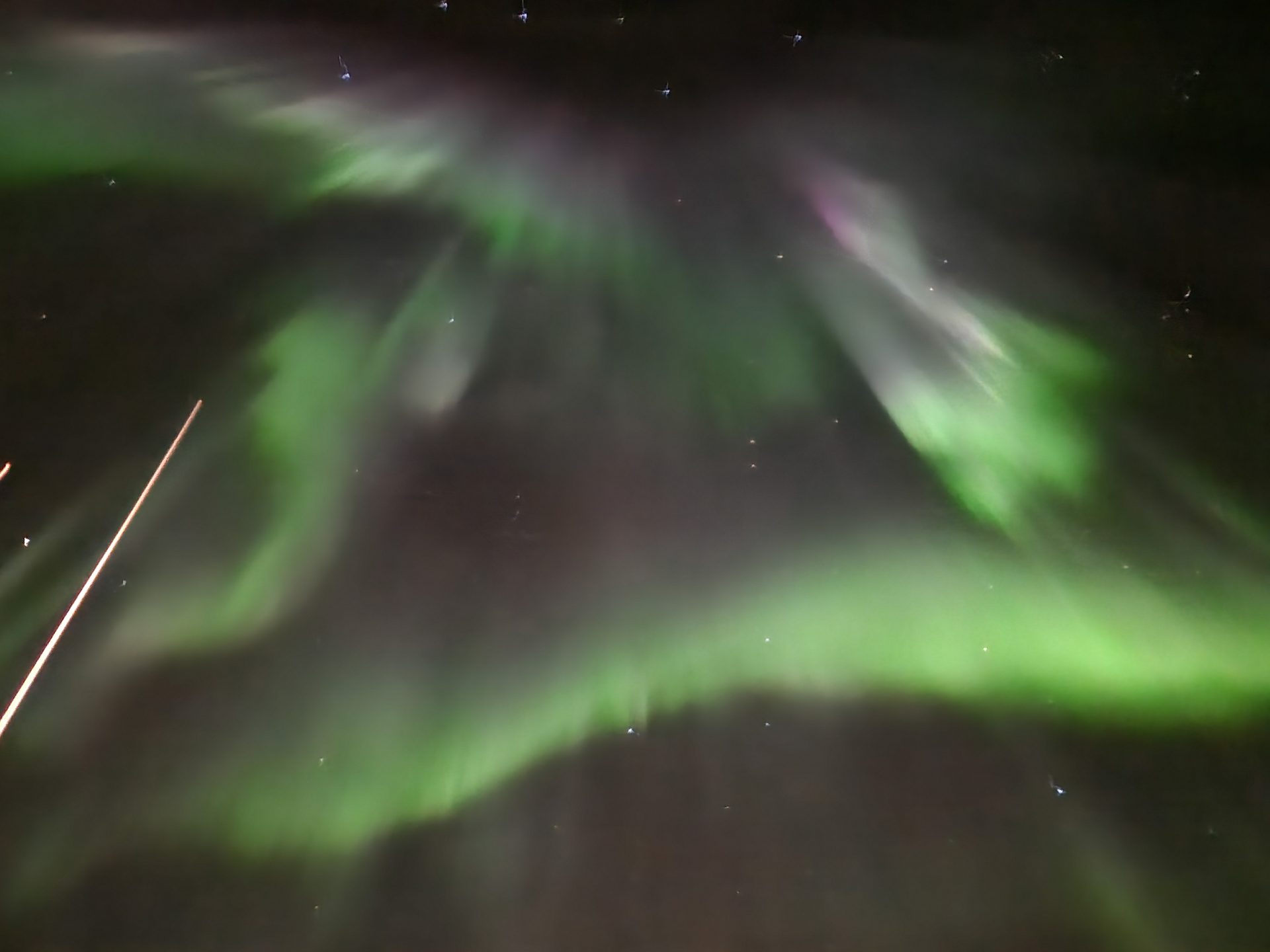
A camera has no such limit. Open the shutter for a few seconds and it quietly collects light the whole time, stacking up far more than your eye can gather in a single instant. That long exposure is why a phone or camera can render bold green curtains and pink-purple fringes from a display that looked, to you, like a pale moving smudge.
Neither view is “wrong”. The camera is simply patient in a way human eyes cannot be.
What a faint aurora really looks like
For a modest display — the kind that is far more common than the headline-grabbing ones — expect something like this with the naked eye:
- A soft, pale band or arch low on the horizon, often a washed-out grey or the faintest grey-green.
- Slow movement: the band drifts, brightens, fades, and shifts shape. Motion is usually the first thing people actually notice.
- Little to no obvious colour, especially at first. Colour tends to emerge only as the display strengthens or as your eyes fully adapt.
Many first-timers mistake a faint aurora for a thin streak of cloud — until it moves in a way cloud never does. A useful mental note: a faint aurora is a moving thing first and a coloured thing second. Your eyes catch the motion long before the colour.
When the lights really perform
Strong displays are a different experience entirely, and they do not need a camera to impress. When activity is high, the human eye genuinely sees colour — vivid greens, and in the best shows reds and purples — along with rippling curtains, rays, and that startling sense of the whole sky in motion overhead. People gasp out loud at these. They are rarer and never guaranteed, which is exactly why they are worth the trip and the patience.
The goal here is not to talk down the aurora. It is to make sure that whatever the sky offers on your night — modest or magnificent — you recognise it for what it is and enjoy it fully.
How to see more with your own eyes
You can meaningfully improve what you see, for free, just by treating your night vision with respect:
- Get fully dark-adapted. Rods take time to reach full sensitivity — give it at least 20 minutes in proper darkness before you judge the sky. The faint stuff only appears once you have waited.
- Put the phone away. A single glance at a bright screen resets your dark adaptation and you start the clock again. If you must check something, use a dim red light, which spares your night vision.
- Look up and look wide. The aurora can fill a large part of the sky, not just the horizon. Scan slowly rather than fixing on one spot — your peripheral vision is especially good in the dark.
- Get away from light. Streetlights, lit windows, and even a bright moon all wash out faint detail. The darker your surroundings, the more your eyes can pull from the sky.
- Give it time, and stay warm. Displays come in waves. A quiet sky can come alive twenty minutes later. Being comfortable enough to wait is half the battle.
Set fair expectations, then go
The aurora is one of the few natural wonders that genuinely rewards patience and managed expectations. Go expecting a vivid green photograph and a faint night may disappoint you. Go knowing that your eyes see motion before colour — and that a strong display, when it comes, needs no camera at all — and almost any night under a clear, dark sky becomes something to remember.
The hardest part is simply being out there on a night when the sky is dark, clear, and active at the same time. That is precisely what our free aurora app is built to tell you: a single honest Tonight Score that only says “go” when you could actually see the lights. No ads, no tracking, no crying wolf.
Check tonight’s score before you head out — and if a proper aurora trip to the Arctic is taking shape in your mind, Jo plans the journeys to Norway and is always happy to talk it through.
Above: Green and faint pink aurora bands twisting overhead with stars above a low dark skyline..
Ready to put it into practice?
Check tonight's honest forecast for free, or plan a journey to where the aurora lives.