Aurora planning · 4 min read · Updated July 2026
What a G2 Watch Actually Means for Your Cruise Week
A plain-English guide to the NOAA G-scale — and what a G2 watch does (and does not) mean on your ship
A G2 watch does not mean 'go outside now'. It means 'there is a real chance of activity tonight, if the sky is clear'.
If you have ever chanced a northern-lights trip and felt let down by the forecast, you are not alone. Most guides talk about Kp-index values, G-scale watches, and solar flares in a language that sounds clever but means very little to someone standing outside in a cold Norwegian night.
This is a plain-English guide to what a G2 watch from NOAA actually means — especially if you are on a cruise while you chase.
The short answer
A G2 watch does not mean “go outside now.” It means “there is a real chance of activity tonight, if the sky is clear.” That is the critical difference between a watch and a guarantee.
Here is what a G2 watch actually tells you:
- A moderate geomagnetic storm is expected. G stands for “geomagnetic”. The number (2) is the intensity level on the NOAA geomagnetic storm scale, which goes from G1 (weak) to G5 (extreme). G2 is moderate — enough to see aurorae at high latitudes and possibly further south. [JO-VERIFY: Does this accurately explain the G-scale in plain terms Jo would agree with?]
- It is not a weather forecast. The G-scale tells you about the sun, not the sky. It says nothing about cloud, darkness, or the Moon. A G2 under cloud is exactly the same as a G1 under cloud: nothing to see.
- It is a watch, not an alert. “Watch” means “expect it.” It does not mean “it is happening right now.” The storm may build over several hours, peak, and fade. You are being told to plan for a good night, not to rush out immediately.
The scale, in plain numbers
| Level | Name | What you see (clear skies) |
|---|---|---|
| G1 | Weak | The aurora usually visible at high latitudes (northern Scandinavia, Alaska, northern Canada). If you are in northern Norway, the chances are good. |
| G2 | Moderate | Aurorae may be visible at lower latitudes than usual. From a ship between Tromsø and the Lofoten Islands, you have a real shot. |
| G3 | Strong | Visible well south. You may see aurorae from further south than usual. From a Norwegian ship, it is a safe bet on a clear night. |
| G4 | Major | Seen at low latitudes. From Norway on a clear night, this means curtains and possibly pink fringes. |
| G5 | Extreme | Aurorae seen at very low latitudes. From Norway, expect a spectacular, possibly colour-rich display. |
A G2 watch is the sort of night most people on an aurora cruise would be pleased to see. It is not the most spectacular level — that is G3 and above — but it is reliable enough to put you under the sky with good odds.
What a G2 watch does not mean
A G2 watch does not mean:
- You will definitely see lights. If the sky is above 70% cloud, you are unlikely to see anything, regardless of the G-value.
- The lights will be bright. A G2 is moderate. Expect green bands, possibly pink fringes if you are looking for them, and definitely not the kind of show that fills an entire sky — unless there is also a G3 or G4 in the mix.
- The lights will last long. Auras can last minutes or hours. A G2 watch tells you nothing about duration.
- The lights will be in a fixed position. They move. They shift. You may see them on one side of the sky one minute and not the next. The G-scale says nothing about movement.
Why G-codes matter on a cruise
If you are on a cruise, G-codes are important for practical reasons:
- Decks are safer than land. On a stormy G2 night, the sea keeps you away from the weather on a cruise far more reliably than walking on a mountain road. The ship’s open decks let you see the sky without braving icy land routes.
- Mobility helps. A ship can move towards cloud gaps. If a G2 watch puts you under the weather, moving north or south of the main system is exactly the kind of advantage that separates seeing something from seeing nothing.
- The crew can help. On a well-run aurora-focused cruise, the crew or a naturalist will often share the G-scale forecasts with guests and suggest when to head on deck.
How to use a G2 watch on your cruise
Here is the practical thing to do:
- Check cloud first. Before you rush on deck, look at a cloud forecast. If it is mostly clear, a G2 watch is reason enough to be out.
- Go on deck, but be ready to move. If the ship offers deck viewing, use it. If not, head to the open areas — the top deck, the bow — where the horizon is clear.
- Keep your eye out for the whole night. A G2 watch can peak and fade. Go back out if the forecast calls for another peak later.
- Check the app. Our free Tonight Score combines the G-scale with cloud, darkness, and moonlight into a simple go/no-go. It will tell you if a G2 watch is worth following.
The bottom line
- A G2 watch means: moderate geomagnetic activity expected. If the sky is clear, you have a real chance of seeing aurorae.
- A G2 watch does not mean: go outside now, the lights are guaranteed, they will be bright, they will last long.
- Use cloud, darkness, and moonlight to decide whether to actually go out. The G-scale is useful, but it is only one part of the picture.
If you’d like help planning a trip around aurora forecasts and G-scale watches, Jo can help you think through a cruise to Norway. True Frontier In Action does not book travel — but Jo does, and she plans aurora journeys with ATOL protection.
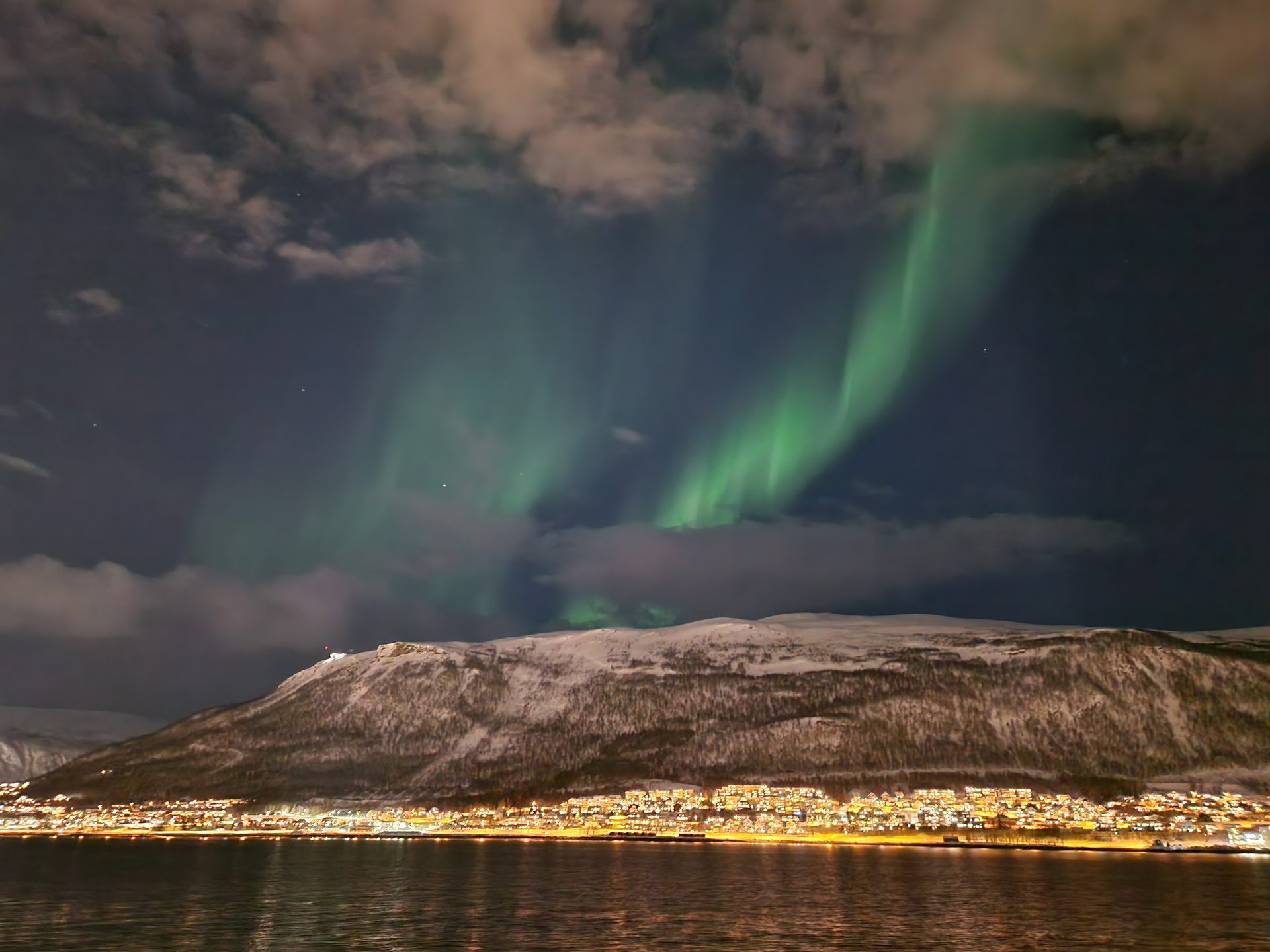
Above: Aurora over a Norwegian fjord at twilight..
Ready to put it into practice?
Check tonight's honest forecast for free, or plan a journey to where the aurora lives.