Aurora forecasting · 5 min read · Updated July 2026
What Does an Aurora Forecast Tonight Mean — And How to Read It
The aurora forecast tonight isn't just a Kp number — it's a multi-factor verdict from activity, darkness, cloud and moon. Here's how to read it and what to expect.
A forecast that only says go when you could actually see something saves you from freezing under cloud for nothing.
When you open an aurora app and see a Tonight Score — a big number, a GO / NO-GO verdict, maybe a flashing alert — you’re looking at the output of a specific system. It is not a single number pulled from space weather, and it is not a guess. It is a verdict, built from four independent factors, two of which are hard gates. Understanding what that means — and how to read the result — can save you a wasted night, hours of travel in the freezing cold, and a lot of disappointment.
What is an aurora forecast tonight, exactly?
A responsible aurora forecast does not just tell you whether the Sun is active. The Sun is always doing something — flares, coronal mass ejections, quiet periods. What matters for you on any particular night is not what the Sun is doing, but whether you would be able to see anything even if something spectacular happened. A roaring aurora behind a cloud-covered sky is invisible. A bright aurora under twilight is washed out. What matters to you is the intersection of four things:
- Solar activity — how much energy is arriving from the Sun. This is measured as a Kp-index or G-scale.
- Darkness — is the sky properly dark? If it is still twilight or it is the midnight sun, no aurora will be visible regardless of activity.
- Cloud — is the sky covered? Cloud is an opaque lid; a brilliant storm behind cloud cannot be seen.
- Moon — how bright is the Moon? A full Moon floods the sky with light and washes out faint aurora. Only strong displays survive it.
A good system combines all four. If any one of them closes a gate, the night gets a NO-GO. That is what an aurora forecast tonight should tell you, plainly.
How the Tonight Score works
Here is the logic, simplified:
- Darkness is scored first. If the sky is not dark — deep twilight, midnight sun — the score is zero regardless of anything else. No darkness means no show. Period.
- Cloud is scored next. Even if the sky is dark, if 90% or more of it is cloud-covered, the score drops to near zero. Cloud does not let the aurora through. Period.
- Moon is scored on a scale. A full Moon (100% illuminated) at midnight makes it much harder to see anything faint except very strong storms. A thin crescent (small illumination) has almost no effect. The score penalizes brightness proportionally.
- Solar activity measures the geomagnetic energy arriving at Earth’s magnetic field. High activity means the aurora is energetically capable of being visible. But high activity alone is never enough — it contributes only to the score, it never overrides darkness or cloud.
The final Tonight Score is a single number, typically 1–100, that combines all four factors. A GO threshold (usually around 35–45 depending on the season) separates nights worth stepping outside from nights better spent sleeping.
What a GO verdict actually means when the aurora forecast tonight says go
When the forecast says GO, it means:
- There is solar activity arriving at Earth’s magnetic field.
- The sky will be dark enough at dusk and night for an aurora to be visible.
- Cloud cover is expected to be low enough for significant viewing.
- The Moon will not drown out a moderate aurora display.
This is not a guarantee. A rapid cloud front can move in at short notice. A storm stronger than expected could arrive and shift the aurora from overhead to the northern horizon. But the probability of seeing the aurora is substantially higher than on a NO-GO night.
What a NO-GO verdict means when the aurora forecast tonight says no
A NO-GO is not a statement that nothing is happening in the sky. It is a statement that you will not be able to see it. This is the part that gets people confused. A strong aurora storm can be raging overhead while an aurora forecast tonight gives a NO-GO — because the sky is cloudy or it is too bright outside for you to see it. The system does not cry wolf; it is protecting you from driving out into the cold for nothing.
A NO-GO means one or more of the following is true:
- The sky will not be dark enough (e.g., deep twilight, or too close to the midnight sun).
- Cloud cover is too heavy (typically above 80% or so).
- The Moon is too bright for anything but strong aurora to be visible (and solar activity isn’t high enough to overcome it).
- A combination of medium darkness, medium cloud and a bright Moon brings the total to zero.
Why most aurora apps are wrong
Many popular aurora apps work differently. They give you a percentage — “70% chance of aurora” — based entirely on the Kp-index. They tell you nothing about cloud, darkness or the Moon. If you are using an app that only checks solar activity, you are effectively rolling the dice every night. You will get false positives frequently. After three false alarms in a row, you stop trusting the app and miss the night it was actually right.
An honest Tonight Score system avoids this by gating on darkness and cloud first. It does not tell you to go out unless all the practical conditions line up. It is the difference between “there is aurora activity” and “you can see it.”
How to read your forecast tonight before heading out
When you check the forecast tonight, follow this simple checklist:
- Look at the verdict first. GO means the math is in your favour. NO-GO means save yourself the trouble.
- Check the cloud forecast. Even a GO can be ruined if a weather front moves in. Look at hourly cloud and be ready to move.
- Check the Moon phase. A very bright Moon at night means you need stronger activity to see anything faint.
- Check the horizon direction. If the app gives you a bearing, note which way the aurora is expected to be. It is almost always in the north if you are in the northern hemisphere.
- Be ready to move. Conditions change. A GO can turn into a good viewing night if cloud clears, or it can be ruined by sudden cloud.
The difference between a wasted night and a magical one is preparation — and knowing what the forecast is actually telling you.
When the aurora forecast tonight is the most useful
The forecast system is useful every night during aurora season, roughly late August through March in the northern hemisphere. But it is especially valuable during:
- Geomagnetic storms (G2/G3 and above) — when the Kp-index jumps, the app helps you judge whether a storm is actually visible or just energy without visibility.
- Equinox months (September and March) — when the Earth’s magnetic field alignment makes aurora more likely, but cloud and darkness can vary widely night by night.
- Full moon windows — when the Moon brightness makes faint aurora harder to see, and the system helps you separate strong displays from invisible ones.
- Winter months (December/January) — when long hours of darkness make aurora likely from a darkness perspective, but cloud can be a massive wildcard.
You do not need to check every night. Even during peak season, checking two or three nights before your planned viewing gives enough data to know whether to expect something.
The bottom line: trust a forecast that tells you to stay in
The most important thing about an aurora forecast tonight is this: a responsible system will occasionally say no. A responsible system will occasionally say nothing to see — even when storms are raging overhead. That is not the system being wrong. That is the system protecting you from driving out into the freezing dark for nothing.
Save your energy. Check your forecast. Our free Tonight Score is built exactly this way — darkness and cloud as hard gates, moon and activity weighed honestly, one plain go/no-go. When it says GO, step outside. When it says NO-GO, trust it.
And if reading forecasts has you thinking about a proper trip north, Jo plans aurora journeys to Norway around exactly these factors — the dark months, the clear-sky country, the margin of extra nights. True Frontier In Action does not book travel — but Jo does, through an ATOL-protected travel company.
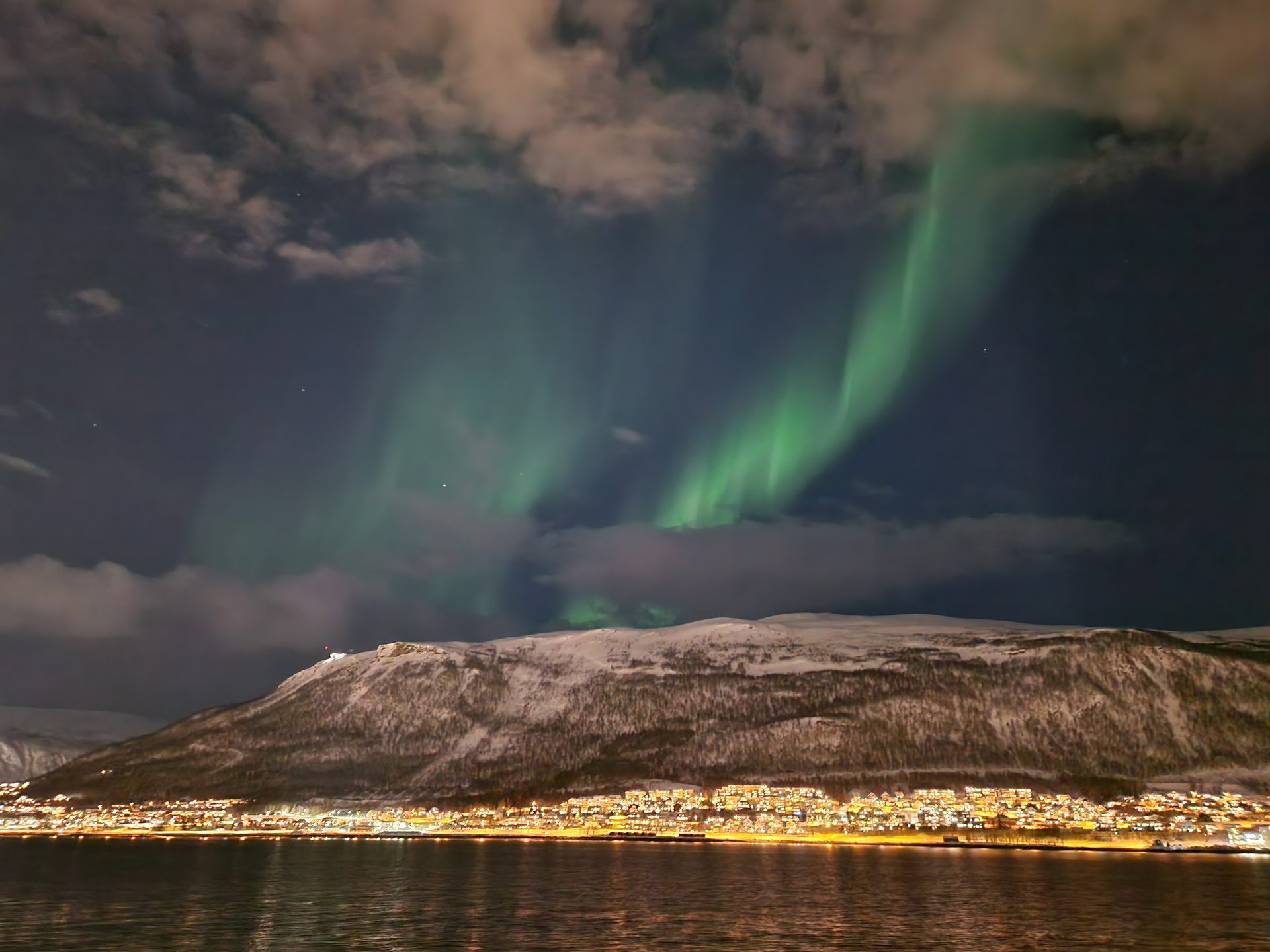
Above: Bright green aurora rays streaming down across a dark night sky over a fjord..
Ready to put it into practice?
Check tonight's honest forecast for free, or plan a journey to where the aurora lives.