Aurora planning · 4 min read · Updated July 2026
Tromso vs Alta vs Kirkenes: Where Is Best for Aurora?
An honest comparison of three Norwegian aurora bases — and how to pick the one that suits your trip
Each of these bases has a different relationship with the sky. Tromso is the warm, easy first stop. Alta is the quiet expert. Kirkenes is the wild edge.
Three names come up again and again when people plan a trip to see the northern lights in Norway: Tromso, Alta, and Kirkenes. All three sit inside the auroral zone — the belt of sky where the lights appear most often — and all three are reachable in roughly the same travel time from central Norway.
The thing is, they are very different places.
Here is a straightforward comparison to help you pick the one that suits your trip.
Tromso: the warm, accessible first stop
Tromso is the most popular aurora destination in Norway. It sits on an island, north of the Arctic Circle, with a population of roughly 75 000. The city is compact and walkable, with a centre full of caf, restaurants, and a harbour that faces the sea.
What makes Tromso good:
- Easy to reach. Tromso has an airport with regular connections from Oslo and other Norwegian cities, plus international flights in peak season.
- Infrastructure. You have a full city at hand — hotels, restaurants, guided tours, aurora forecast apps, and people who speak English fluently.
- Close to the sea and mountains. The city is surrounded by fjords and hills. The sea gives you open horizons; the hills give you elevation.
- Warmth. If the cold gets too much, you can retreat into a warm caf or restaurant in ten minutes.
For aurora viewing:
- Tromso sits just inside the auroral zone. That means you have a good chance of seeing the lights, especially during the peak season (September through March).
- The nearby mainland — islands like Kvaloy and Senja — offers darker, more remote viewing spots.
- Cloud is the biggest enemy. Norway is famously rainy, and Tromso is on the coast, where the weather is changeable.
Pros and cons:
| Pros | Cons |
|---|---|
| Well-connected, easy to get to | Crowded during peak season |
| Full city amenities | Light pollution from the city centre |
| Good for first-time aurora chasers | Cloud and wind are frequent |
| Close to fjords and islands | Less “wild” than deeper Arctic |
Tromso is the place I recommend when people are seeing the aurora for the first time or want a trip that balances the lights with comfort and culture.
Alta: the quiet expert
Alta is a smaller city, further south-east than Tromso, in Finnmark. It has a population of roughly 21 000 — small enough to be quiet, large enough to be useful. Alta is known as Norway’s “Aurora City” and the weather here has a reputation for being clearer than on the coast.
What makes Alta good:
- Fewer clouds. Alta is in a sheltered valley, where the surrounding mountains help keep cloud out more often. The local weather is drier than the coast, which means more clear nights.
- Less light pollution. The city is small and spread out. You can reach dark spots with a short drive or bus ride.
- Aurora expertise. Alta has a reputation built over many years. It attracts serious aurora hunters, and the local infrastructure — guides, hotels, even restaurants — is oriented around the lights.
- Affordability. Alta tends to be less expensive than Tromso, partly because it is smaller and less touristy.
For aurora viewing:
- Alta sits further south, but its sheltered location compensates. You get fewer clouds and more clear nights than Tromso.
- The surrounding landscape — mountains, fjords, and open tundra — gives you dark horizons and good visibility.
- It is not as far north as you might expect, but the clear skies make up for it.
Pros and cons:
| Pros | Cons |
|---|---|
| Fewer clouds on average | Fewer direct flights from abroad |
| Less light pollution | Smaller city, fewer amenities |
| Strong aurora reputation | More rugged, less tourist-friendly |
| Good value for money | Less “cozy” than Tromso |
Alta is the place I recommend when people care about clear skies above all else. If you want the best chance of seeing the lights and don’t mind trading some of the city for silence and mountains, Alta is a great choice.
Kirkenes: the wild edge
Kirkenes is a small town in the far north-east of Norway, near the Russian border. It has fewer than 10 000 inhabitants and sits on the edge of the Barents Sea. It is perhaps the wildest of the three. [JO-VERIFY: Is Kirkenes worth recommending as an aurora base? Any practical issues visitors should know about near the Russian border?]
What makes Kirkenes good:
- True Arctic. Kirkenes is far north, far from population centres, far from light pollution. The surrounding landscape is tundra, mountains, and the sea.
- Darkness. With almost no light pollution, Kirkenes is dark — which means the aurora shows up more vividly than anywhere else on this list.
- Wilderness. You are on the edge of Finnmark. The weather is harsh, the landscape is open, and the silence is real.
- Uniqueness. Kirkenes is a destination in its own right. It is the only Norwegian town you can reach by train from Moscow, by ferry from the Barents Sea, or by road through tundra.
For aurora viewing:
- Kirkenes is far north, which means you are under the auroral belt for longer hours during the dark season.
- The darkness is exceptional — the surrounding tundra and sea are virtually devoid of light pollution.
- The weather is the trade-off: the far north has more severe storms, and the landscape is wild and exposed.
Pros and cons:
| Pros | Cons |
|---|---|
| Exceptional darkness, minimal light pollution | Hardest to reach of the three |
| Far north, under the auroral belt | Fewer amenities and services |
| True Arctic wilderness experience | Weather can be severe |
| Unique and off-the-beaten-path | More expensive (travel) |
Kirkenes is the place I recommend when people want the real high-Arctic experience — the kind of trip where the aurora feels earned, where the cold and the distance and the silence make the lights feel like something more than a spectacle.
A quick comparison
| Tromso | Alta | Kirkenes | |
|---|---|---|---|
| Best for | First-time aurora chase | Clear skies above all | True Arctic wilderness |
| Cloud risk | Moderate | Lower | Moderate-high |
| Light pollution | Medium | Low | Very low |
| Accessibility | High | Medium | Low |
| Amenities | Full city | Small town | Minimal |
| Cost | Moderate | Lower | Higher (travel) |
| Wilderness | Moderate | High | Exceptional |
There is also a fourth option, of course — but this guide is about these three.
What I recommend
Each of these bases has a different relationship with the sky.
- If you want the warm, easy first stop, and the lights are a welcome bonus, go to Tromso. It is accessible, comfortable, and the aurora is often good enough on a clear night.
- If you want the clearest skies, and you are willing to trade city amenities for silence and mountains, go to Alta. It is the quiet expert — the place where the aurora works because the weather works.
- If you want the wild edge and the real high-Arctic experience, go to Kirkenes. It is the most remote, the most rugged, and the most rewarding.
No one can guarantee the northern lights. But each of these bases gives you a different kind of chance — and all three are inside the auroral zone, which means they are all worth considering.
If you want to discuss which one fits your trip, I am happy to help. Jo plans aurora journeys to Norway and can advise on the trade-offs between these three bases, depending on the kind of traveller you are.
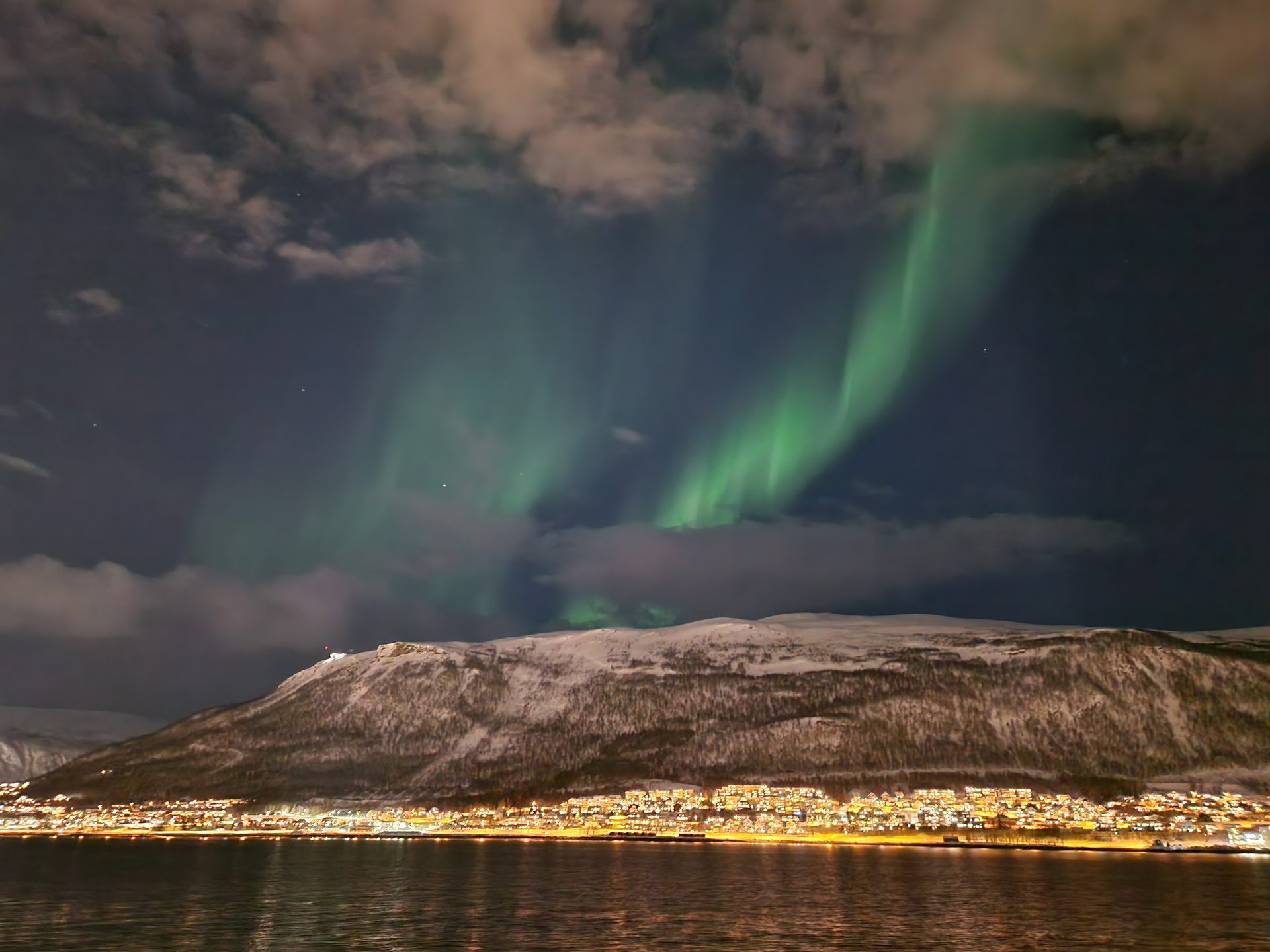
Above: Aurora over a Norwegian fjord at twilight..
Ready to put it into practice?
Check tonight's honest forecast for free, or plan a journey to where the aurora lives.