Aurora planning · 4 min read · Updated July 2026
Norway Aurora Cruises: When to Book 2027 Sailings
Booking tips for 2027 Northern Lights cruises — and why sailing in October gives you better odds than most people expect
The best time to sail for the aurora isn't December or January. It's October — and booking happens much earlier than most travellers think.
There is a particular kind of optimism that people bring to planning an aurora cruise. They imagine December, polar night, the snow piling up to the windows, and then — if they’re lucky — a curtain of green light overhead. It sounds wonderful. And it can be. But the people who have done it a few times tend to steer you towards October.
Here is why.
The aurora season at a glance
The northern lights are a year-round phenomenon above the Arctic. But you can only see them against a dark sky. In northern Norway, the midnight sun washes out the heavens from roughly May to July — so there is simply no darkness to view against. The practical season runs from about late August to early April, with the heart of it in the deep-dark months on either side of midwinter.
This means the aurora season and the booking season are not the same thing. Most people book the December and January dates first, because the romantic idea of polar-night aurora travels fastest. The problem is that the best aurora months — the ones with the cleanest skies — are also the cloudiest, and you are often trading light for wet.
Why October is the quietly smart month
October sits at the top of my list for a few practical reasons:
- The skies tend to clear. Late summer and early autumn can be surprisingly reliable. Cloud is the single biggest enemy of aurora viewing — far more important than solar activity — and October often offers a window before the full winter weather arrives.
- The solar activity is usually still strong. [JO-VERIFY: Is the current solar cycle still peaking into 2027? Will this be relevant for October bookings?]
- The daylight is still reasonable. You can still do a proper daytime excursion, walk along the quay, find a warm cup of coffee. Polar night is beautiful, but it is also short — there is less to do besides wait for the lights.
- The crowds are smaller. Peak-season cruises run high in demand from December through February. October sits in the quieter shoulder, which means better prices, less crowded decks, and a calmer ship.
October is not perfect, of course. The darkness is still growing each week. Some storms can hit hard. But the trade-off — fewer clouds, reasonable daylight, lower demand — tends to favour it.
Solar maximum and 2027
This is the part that most people do not plan around. The Sun runs on roughly an eleven-year cycle of activity, and most forecasts put us near the peak of Solar Cycle 25 through 2026 and into 2027. That means stronger and more frequent auroral displays than in the quiet years of the cycle — a genuinely favourable backdrop for a 2027 trip. [JO-VERIFY: Solar Cycle 25 peak timing — is late 2024/2025 accurate? Will activity remain strong through 2027?]
This is worth bearing in mind when you are looking at booking windows.
When to book a 2027 cruise
Aurora-season cruise sailings tend to sell out well in advance — anything from six to twelve months ahead. If you want a specific departure date in October or November for 2027, you are unlikely to find flexibility if you wait until the spring.
Here are some practical tips for booking:
- Book early for peak months. December through February sell out fastest. If those dates matter to you, aim to book by September or October 2026.
- Shoulder-season sailings have more room. October and March departures tend to have better availability, but if your dates are set, booking now rather than waiting is always the safer move.
- Look for flexibility. A cruise that lets you shift dates within the season is worth more than one locked to a fixed calendar. Weather is unpredictable, and the ability to reschedule a night or two can be the difference between seeing the lights or not.
- The solar maximum is not something to miss. If 2027 is indeed near the peak of Cycle 25, it may not happen again for another eleven years. Planning well in advance gives you the best dates, the best prices, and the most flexibility.
Cruise versus land-based
The other question people ask is whether a cruise is a better way to see the aurora than staying in a hotel or lodge. There are advantages:
- Mobility. A ship can move away from cloud. On land, you are stuck where you are, driving an hour to find a gap if you are lucky. At sea, the vessel can sail towards clearer skies.
- Open decks. Most ships have open-air decks where you can stand under the sky without having to dress for a walk in minus temperatures.
- Dark horizons. If you are sailing along the coast, the sea gives you unobstructed views in all directions.
But there are trade-offs. A cruise can be expensive. The weather at sea is wilder — on some nights, you will not want to go on deck at all. And not every aurora cruise is designed with you in mind; some are just scenic voyages that happen to pass through the auroral zone, without any real focus on the lights.
This is why I always say: talk to Jo before you book. She can point you to the cruises that actually run during the aurora season in Norway, and help you decide whether a cruise is the right choice for your trip. True Frontier In Action does not book travel — but Jo does, and she plans aurora journeys with ATOL protection.
The honest bottom line
If you are planning a 2027 aurora cruise for Norway, here is my quick summary:
- Aim for October–November sailings for the best mix of clear skies and reasonable daylight.
- Book by September or October 2026 for peak months (December–February).
- Take advantage of the solar maximum timing — if 2027 is near Cycle 25’s peak, it will not repeat for another eleven years.
- Talk to Jo about whether a cruise fits the kind of trip you want.
No one can guarantee the northern lights. But the people who give themselves the best chance are usually the ones who plan early, pick the right months, and keep their expectations honest.
And before you go, use the free Tonight Score each evening on your trip — it only says “go” when darkness, cloud, moon and solar activity all line up.
When you are ready to plan, Jo can help you think through an aurora cruise to Norway. She does not sell cruises or book trips, but she is always glad to help you think it through.
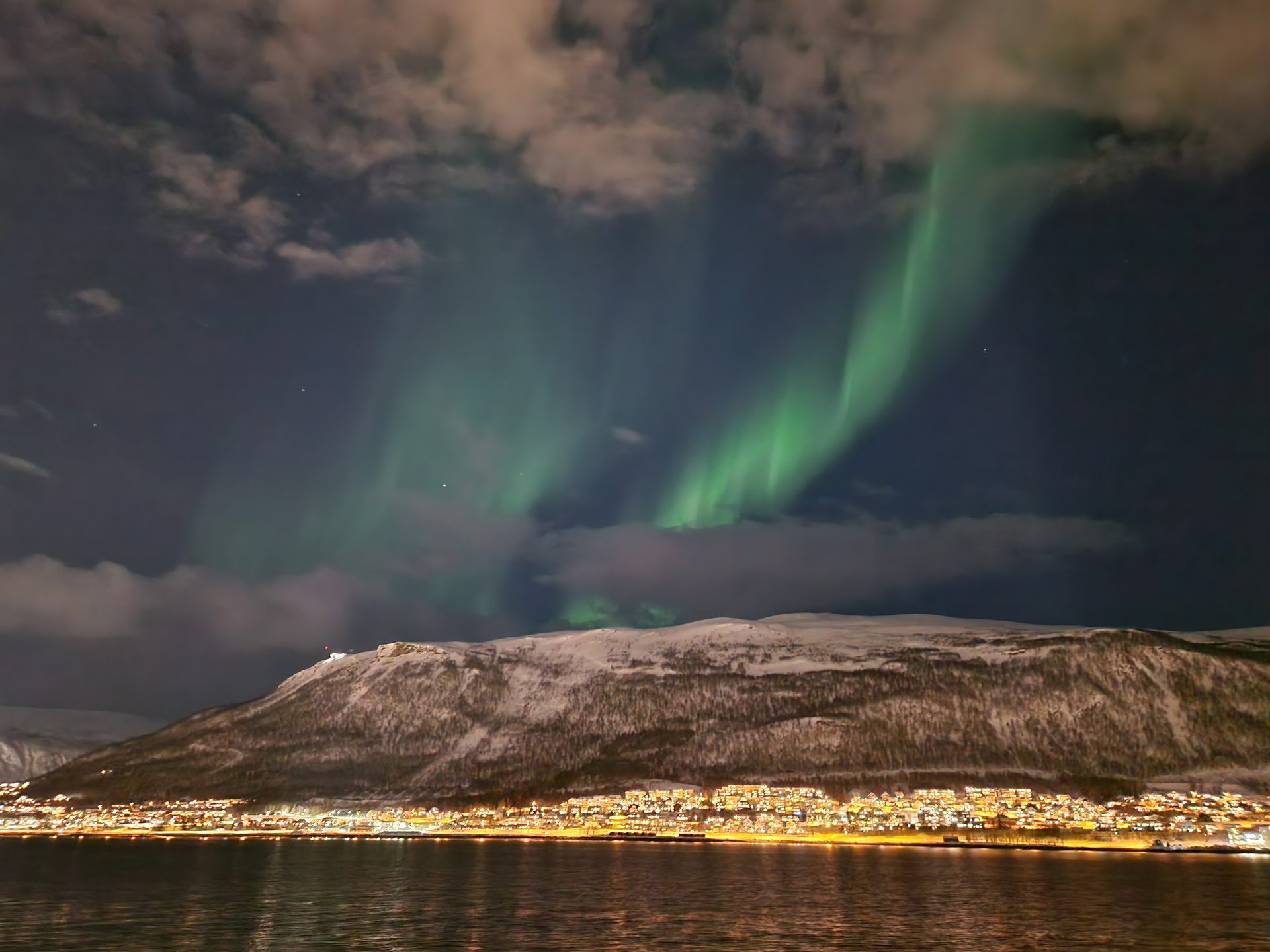
Above: Bright green aurora ribbon arcing over a snow-culled ridge above the golden lights of Tromsø..
Ready to put it into practice?
Check tonight's honest forecast for free, or plan a journey to where the aurora lives.