Aurora planning · 5 min read · Updated July 2026
Northern Lights Season Calendar: 2026/27 Month by Month
The aurora season runs from late August to early April, but each month trades something different. This is the month-by-month season calendar for 2026/27 — darkness, cloud, activity and crowds.
The equinox months — September and March — are statistically the strongest. But the best month for you depends on where you are and what kind of experience you want.
Knowing how the aurora season unfolds month by month helps you plan a trip that rewards you most. But “best” has two meanings: the months with the strongest aurora activity, and the months with the clearest, darkest skies. When both align, you get a truly memorable viewing experience. This calendar walks the whole 2026/27 season; if you want the Norway-specific verdict on picking a month, our evergreen guide to the best time to see the northern lights in Norway pairs with it.
The short answer
The best months for the northern lights, broadly speaking, are September and March — the equinox months. These are statistically strong for geomagnetic activity, which makes aurora appear more frequently and with more intensity. They are also shoulder months: cold enough for dark skies, but typically milder and calmer in weather than the heart of winter. The heart of the aurora season runs from late August to March, with December through February delivering the longest hours of darkness.
Here is the month-by-month breakdown.
Late August — early September: Season opens
Northern lights become visible again as the midnight sun fades and true darkness returns. In the far north, this happens around late August. The sky is still relatively mild, and the first aurora of the season is usually a thrilling sight.
- Darkness: Moderate — short dark hours, increasing each night.
- Cloud: Generally moderate.
- Moon: Variable.
- Expected activity: Good.
September is when the real aurora season begins in earnest. By early September, you have several hours of dark sky each night, and geomagnetic activity is typically strong.
September: Equinox month — a top choice
September is widely considered one of the best months for the northern lights. The Earth’s magnetic field is optimally aligned with the solar wind during the autumn equinox, making geomagnetic storms more likely. September gives you:
- Long dark hours by the end of the month (up to 10–12 hours of darkness by late September in the far north).
- Relatively mild weather compared to midwinter — you do not need extreme cold-weather gear for most of the month.
- Good cloud conditions in many Arctic locations.
- Peak equinox activity for the solar cycle.
September is a top tier month for aurora viewing. It is especially good for first-timers who want a balance of darkness, manageability and strong odds.
October through November: Deepening dark, increasing storms
As the autumn progresses, darkness becomes the dominant factor. Each day gets noticeably shorter. By October, you have 8–12 hours of darkness each night in the far north. This means more opportunities to see the aurora each evening.
- Darkness: High — long nights give many viewing windows.
- Cloud: Variable. Coastal locations can be cloudier; inland and mountain locations tend to be clearer.
- Storm activity: Geomagnetic storms increase as the solar cycle peaks.
October and November deliver the classic Arctic experience: deep darkness, cold, and frequent aurora activity. They are among the most popular months for aurora hunters.
December through February: Peak darkness
The heart of winter brings the longest continuous hours of darkness — up to 20 hours in parts of northern Norway, Finland and Iceland at the December solstice. For aurora viewing, longer darkness means more potential viewing time each night. However, there are trade-offs:
- Darkness: Maximum — up to 20+ hours of potential viewing window each night.
- Cloud: Can be high in many locations. Coastal areas often see more cloud cover. Inland and high-altitude sites tend to be clearer.
- Temperature: Cold — often well below freezing. Good weather gear is essential.
- Storm activity: Moderate to high, depending on the solar cycle phase.
The deep winter months are peak for darkness but not necessarily peak for all factors. Cloud cover is the main risk. You need reliable forecast tools to avoid wasted nights.
March: The second equinox month — often the best
March is the second equinox of the year. Like September, it is statistically strong for geomagnetic activity. But March has something September does not: it is closer to the end of the polar night, so you get both aurora viewing in the evening and daylight for other activities.
- Darkness: Good — nights are dark but not as extreme as midwinter.
- Weather: Improving — gradually milder as spring approaches.
- Activity: Typically strong during equinox months.
- Daylight: Plenty for daytime activities and photography.
Many experienced aurora chasers consider March — along with September — the absolute best month for a balanced aurora experience. You get strong activity, decent darkness, improving weather and the bonus of daylight hours.
April onwards: Season winds down
By April, the midnight sun begins to return. By May, it is fully back in much of the Arctic. The aurora season effectively ends in late March or early April, depending on location and year.
- Darkness: Decreasing rapidly after mid-March.
- Activity: Declining through spring as the solar cycle moves away from its peak.
- Weather: Mild, increasingly daylight-oriented.
2026/27: Solar cycle context
The northern lights are strongest when the Sun is near its activity maximum. Solar Cycle 25 is near or at its peak in 2025–2026, which means 2026 is an excellent year for aurora hunting. Near-peak activity typically lasts 2–3 years around the true maximum, so 2026 and 2027 together form a strong aurora window.
This means:
- More frequent strong displays than in average years.
- Aurora visible at lower latitudes more regularly.
- More opportunities per month overall, especially during equinox months.
2026 is one of the best years in a decade for aurora viewing. Plan accordingly.
What the best months for you depend on
The best month for you depends on your priorities:
| Priority | Best month(s) |
|---|---|
| Maximum viewing hours | December – February |
| Strongest equinox activity | September, March |
| Best balance of factors | September, March |
| Mild weather + decent odds | September, October, March |
| Snow + Arctic wilderness | December – March |
| Fewer tourists, lower prices | October, November, February |
| Strongest 2026 season | September 2026, March 2027 |
There is no single “best” month that is perfect for everyone. But September and March consistently appear at the top of recommendations from both solar-cycle scientists and experienced Arctic travel planners.
How to use this calendar in practice
- Pick your window early. The best months are September through March. Pick the one that fits your schedule and weather tolerance.
- Check forecasts nightly. Even during peak season, a cloudy night is a cloudy night. Use the aurora app’s Tonight Score to decide whether to go out.
- Be flexible. If your dates are flexible, aim for the equinox months (September and March) for statistically strongest activity.
- Plan for 3–5 nights minimum. Even during the best months, cloud and weather can ruin individual nights. More nights = better chance.
- Combine aurora viewing with other activities. September and March give you daylight hours for sightseeing, wildlife, and other Arctic experiences.
The 2026/27 season is a strong one. Plan early, check forecasts, and let the system guide you. Our free Tonight Score does the nightly maths for you — it only says “go” when darkness, cloud, moon and solar activity all give you a real chance. And if a month on this calendar has started turning into a trip in your mind, Jo plans aurora journeys to Norway and can help you turn the right month into a real itinerary. True Frontier In Action does not book travel — but Jo does, through an ATOL-protected travel company.
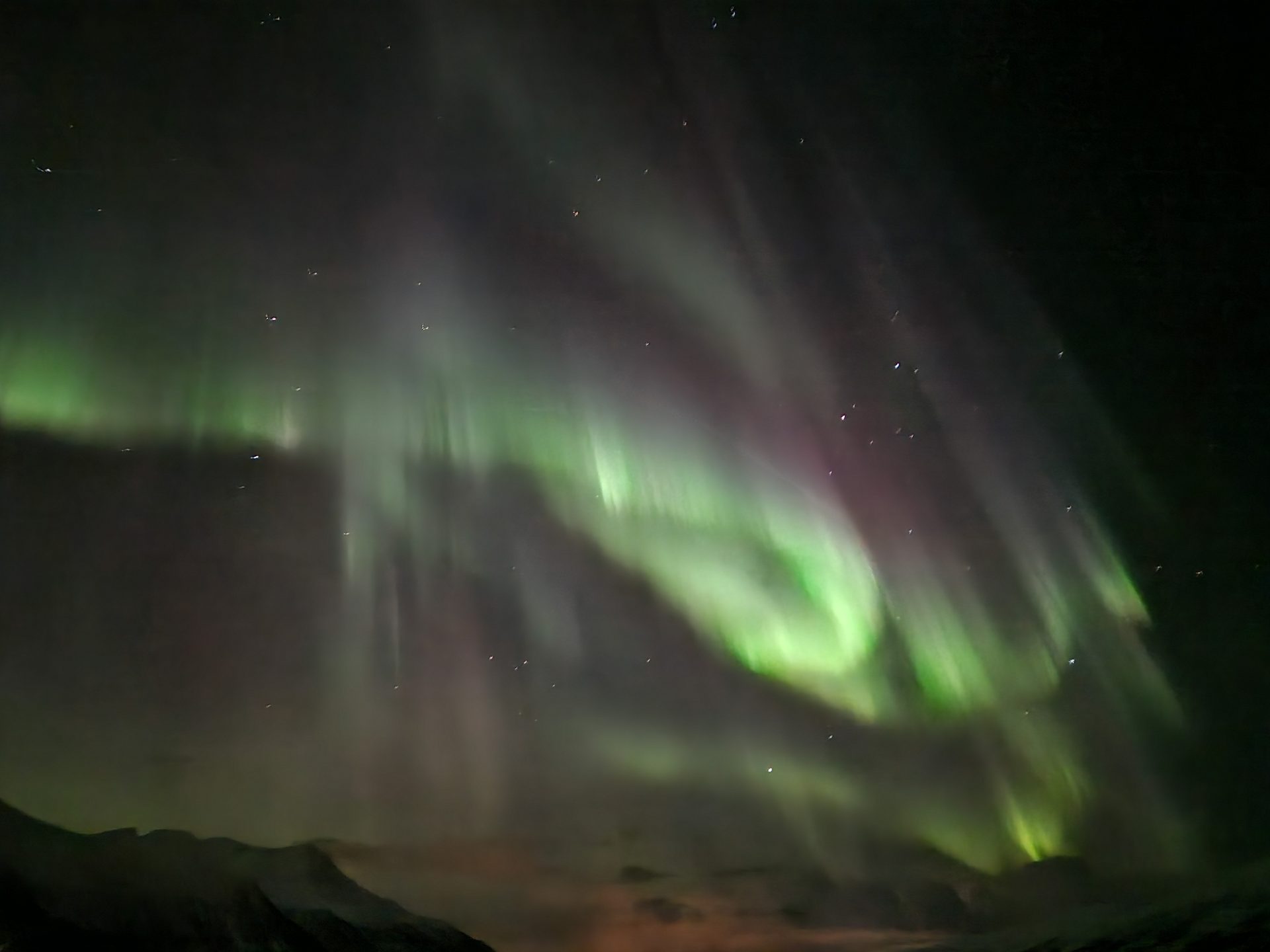
Above: Vivid green aurora rays streaming down across a dark mountain horizon above a fjord landscape..
Ready to put it into practice?
Check tonight's honest forecast for free, or plan a journey to where the aurora lives.